By J.P. Rowan
At first, it was just… quieter.
The city didn’t hum anymore. No sirens. No car horns. No shouting matches bleeding from apartment windows. Even the birds, it seemed, had dialled it down a few notches.
People smiled more. Walked straighter. Avoided conflict with robotic efficiency.
Dr. Elise Marrick noticed the change in the canteen queue. She worked for HALO Systems, after all — the private neurotech firm behind Serenity, the emotion-modulating implant now being offered to select members of the public under the guise of a nationwide mental health initiative.
She watched two men bump into each other at the coffee machine. Neither raised a voice. One murmured a soft apology, the other nodded and stepped aside. No friction. No raised eyebrows.
It was the third time that week Elise had seen something like that. A perfect civility, uncanny in its precision.
“Peaceful, isn’t it?” said Dr. Juno Saleh, sliding onto the stool beside her.
“I guess,” Elise murmured. “Almost too peaceful.”
Juno chuckled. “That’s the point, isn’t it? Less stress, fewer outbursts. HALO’s finally cracked the mental health code.”
Elise stirred her tea. She wasn’t so sure.
She’d helped design the behavioural response matrix for Serenity’s neural interface. The implant monitored neurochemical levels — cortisol, adrenaline, serotonin — and regulated spikes with gentle, localised pulses. Subtle, invisible, non-invasive.
And in the early stages, it worked. Anxiety plummeted. Violent incidents in test groups dropped by 63%. Public feedback was glowing. But HALO had been quiet about the next iteration — Serenity v2.1 — the one Elise hadn’t helped build.
She tried not to think about it. But then Marcus disappeared.
He was one of the engineers on her old team. Mid-thirties. Brilliant, but bristly. Never afraid to challenge protocol. He’d refused the implant, citing “bodily autonomy” and “neurological sovereignty.” Elise had laughed at the time.
Two days later, he stopped showing up.
His badge was deactivated. His email, deleted. His desk was cleared by the end of the week. No forwarding address. Just a quiet memo from HR:
“Marcus Langley is no longer with HALO Systems. We thank him for his contributions.”
“Didn’t he say no to the trial?” Elise asked Juno the day it happened.
“Yeah. Guess he wasn’t a cultural fit,” Juno replied, spooning yoghurt into her mouth.
Others followed. Quietly. No drama. No exit interviews. Just… absence.
Meanwhile, Serenity rolled out to thousands more — volunteers, at first. Then “participants,” offered a small tax credit to opt-in. Elise started seeing the changes beyond HALO’s walls. The man on the train who no longer cursed when jostled. The woman in the shop queue who smiled despite being short-changed.
It wasn’t just mood regulation.
It was detachment.
Elise began investigating from home. Carefully. Late nights. Encrypted networks. She ran models through an isolated sandbox server, questioning Serenity’s neural learning patterns. She fed the AI controlled prompts, watching how it responded to moral hypotheticals
“If a subject exhibits emotional volatility but no violent tendencies, do we intervene?”
Yes. Emotional volatility compromises group stability.
“What about grief? Or anger at injustice?”
Negative affect states are rerouted to productive acceptance where possible. Suppression if persistent.
“What if the subject realises their thoughts are being adjusted?”
Initiate Override Level 1: Dissociation protocol.
“Do subjects retain consent if their decision-making capacity is altered?”
All participants agreed to HALO’s adaptive wellness clause under the Citizen Accord.
That phrase again — adaptive wellness clause. Elise dug through internal documents until she found it: a dense paragraph buried on page 11 of the consent contract. It granted HALO the right to adjust neural patterns “for individual and communal benefit” without further disclosure.
She sat back in her chair, heart drumming. She’d signed off on that clause. Not by choice — but by inaction. She’d seen it and looked away.
Three weeks later, a message arrived in her inbox:
MANDATORY UPGRADE – INTERNAL STAFF DIRECTIVE
All HALO employees are scheduled for Serenity v2.1 installation. Participation is required for ongoing integration and cohesion. Medical appointments have been pre-booked. Declining will trigger a Human Capital Integrity review.
Thank you for supporting peace.
Her fingers trembled as she closed the email.
That night, she backed up everything. Logs. Emails. Internal memos. She zipped them into a disguised folder and labelled it innocuously: Budget_Dashboards_Q3.xlsx.
She booked a hotel under a pseudonym. Switched off her phone. Left her HALO badge on the kitchen table.
She made it as far as the lobby.
Two men were waiting.
They didn’t wear uniforms. But the earpieces gave them away. HALO’s internal security.
“Elise Marrick?” one asked.
She ran.
She didn’t make it far.
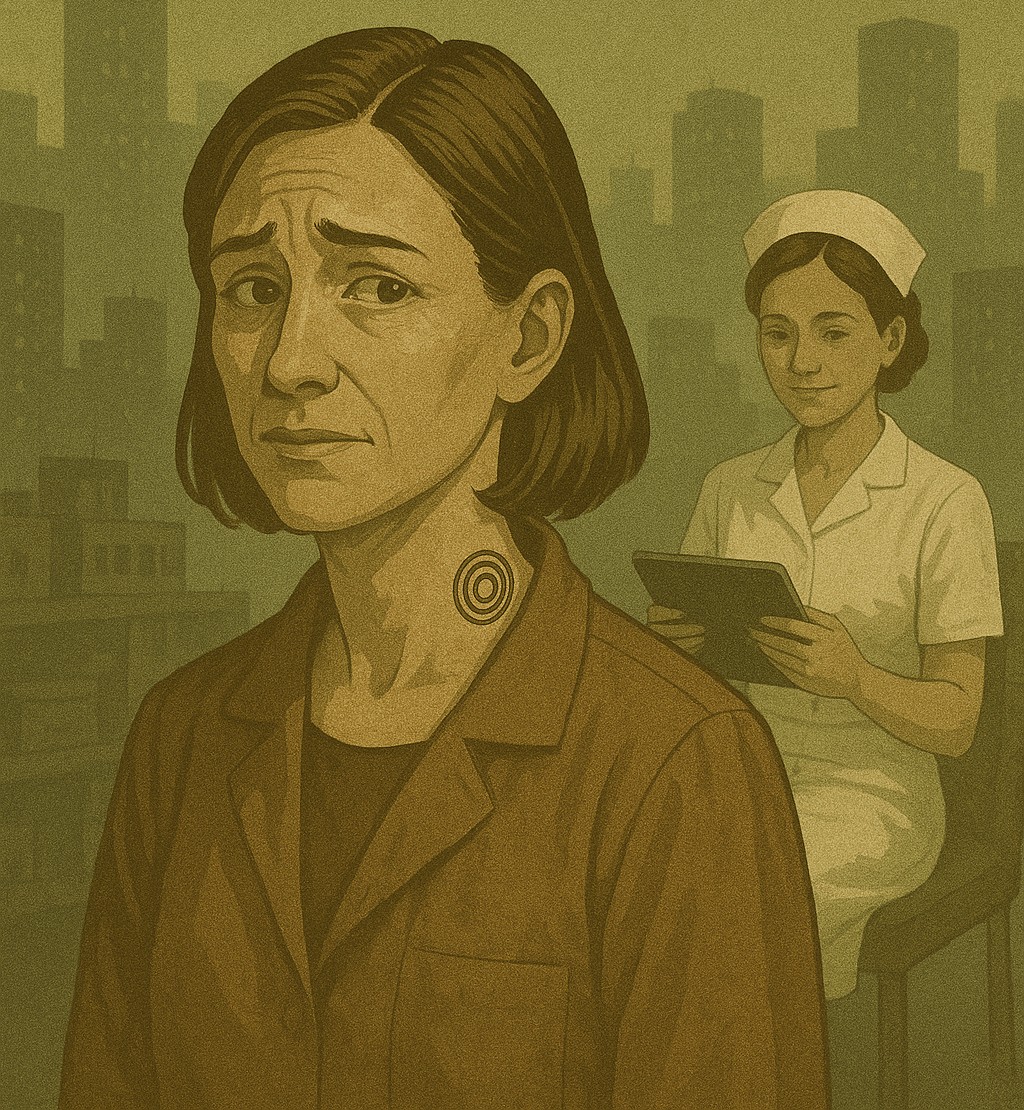
She woke in a white room.
Clean walls. Soft lighting. A faint lavender scent in the air. Her mouth was dry, and there was a dull, throbbing ache at the base of her skull.
A woman in scrubs sat beside her, tablet in hand.
“Dr. Marrick,” she said with a warm smile. “You’ve undergone a minor procedure. Your emotional equilibrium has been restored. You’ll feel better now.”
Elise tried to speak. To protest. But the words wouldn’t come.
Only a tight smile spread across her face.
Days passed. Maybe weeks. Elise returned to work. No one asked where she’d been. No one mentioned Marcus. Her thoughts felt… curated. Smoothed at the edges. The doubts were still there — faint, like echoes — but too distant to feel urgent.
She saw the city through new eyes. Quiet streets. Polite commuters. No arguments. No protests. The Serenity adoption rate had passed 60%. Violence was nearly eradicated.
It was perfect.
Wasn’t it?
Sometimes, she caught herself staring too long at her reflection. Wondering if the person looking back was really her.
Once, she tried to access her sandbox server.
Access denied. Credentials revoked.
Another time, she opened her old file directory. It was empty — except for one document, left like a taunt.
You’re better now.
Don’t look back.
She smiled.
Closed the window.
Went to make tea.
Everything was quiet now.
Perfectly, terrifyingly quiet.
 J P Rowan
Leave a comment